
How to Check a Restoration Company’s ROC License in Arizona
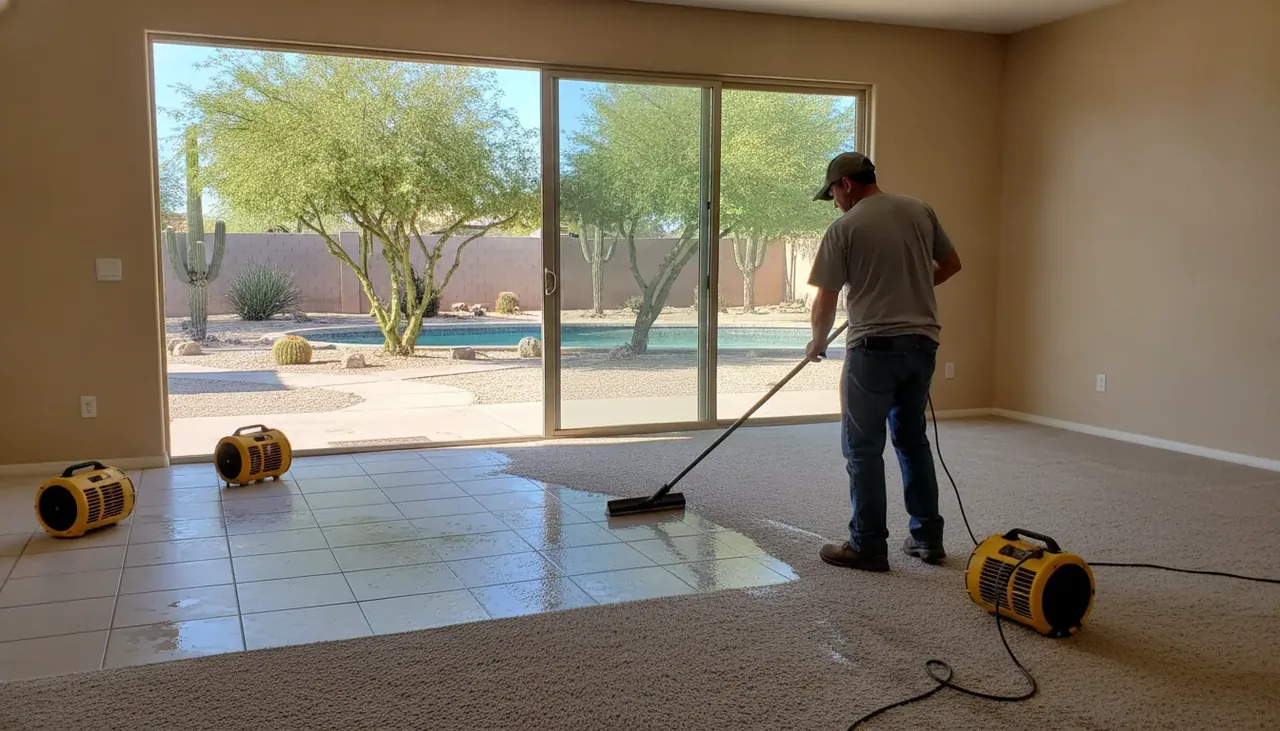
To check a water damage company in Arizona, search its name or license number on the Arizona Registrar of Contractors website, roc.az.gov, before anyone tears out drywall, flooring or cabinets in your home. Arizona law treats that repair work as contracting, and a company holding a license has to print “ROC” and its number on bids, estimates and ads. If the number isn’t on the paperwork, ask for it, then look it up yourself before you sign.
Why the license matters on a water job
Under A.R.S. §32-1101, a contractor is anyone who, for pay, offers to build, alter, repair or demolish part of a structure, whether they do the work themselves or through others. That covers the parts of a water job most homeowners care about: cutting out wet drywall, pulling baseboards, replacing flooring and rebuilding cabinets.
Pure extraction and drying with no repair isn’t spelled out in the statute, and we couldn’t find an ROC ruling on mitigation-only work. Most water jobs end with at least some tear-out (see the six steps of a typical restoration job), so the safe assumption is that the company working in your house should hold a license.
Contracting without a license is a class 1 misdemeanor in Arizona under §32-1164, with fines starting at $1,000. The ROC can also discipline license holders for “false, misleading or deceptive advertising” under §32-1154.
Where the number should show up
A.R.S. §32-1124 says the license number, preceded by “ROC,” belongs on bids, estimates, published ads, letterhead and letters to customers. Internet ads can instead link to a website that prominently shows the company’s name and number, and an ROC policy from 2021 reportedly reads that as the home page, not the footer.
When we reviewed the restoration pages that come up for Chandler searches in October 2026, only one of the top results showed an ROC number on the page. A missing number on a website doesn’t prove anything by itself, but you should expect to see it on the written estimate.
Five-minute license check
- Get the company’s legal name and ROC number from the estimate or bid.
- Search it at roc.az.gov.
- Make sure the name on the license matches the name on your paperwork.
- Note the license class and whether it shows as current.
- If the job includes slab leak pipe repair, check the plumber’s license separately.
Which license class fits water damage work
Arizona has no “restoration” license class, according to a 2023 industry roundup. Repairs to an existing house usually fall under residential classes such as B-3 General Remodeling and Repair, which covers remodeling and repairing existing homes; specialty trades are subcontracted, except carpentry. A general residential B license covers broader work.
Slab leak pipe repair is plumbing work and needs a plumbing license. That is usually a different company from the one drying your tile and baseboards, so a slab leak water damage job often means checking two licenses.
Mold is its own question. Arizona doesn’t have a mold-specific license as far as we could find, so ask about IICRC training and the company’s ROC license for any rebuild after mold after water damage is removed.
The under-$1,000 exemption rarely fits
Arizona’s handyman exemption under §32-1121 only covers jobs under $1,000 total, labor plus materials, that are casual or minor and need no building permit. Splitting one job into smaller invoices to stay under the line isn’t allowed, and anyone advertising under the exemption has to say so in the ad.
Water jobs pass that line fast. A typical restoration job runs $1,200–$5,000, and a Class 3 loss alone runs $1,000–$3,000 (typical ranges from national cost guides (Fixr 2025, HomeAdvisor 2025); East Valley quotes vary). Our Chandler water damage cost guide breaks this down. If someone offers to handle a soaked hallway and two bedrooms as a cash handyman job, that’s a reason to slow down.
Why this comes up so often in Chandler homes
About 73% of Chandler’s housing was built between 1980 and 2009, and the median home dates to 1997, per Census ACS figures. Those houses are now 20 to 45 years old, the age when water heaters, supply lines, copper pipe and tile roof underlayment start to fail. City water averages 16.5 grains per gallon, hard to very hard, which adds scale to heaters and lines. When those fail, the fix usually means opening walls or floors, and that is the part of the job that needs a license.
Older homes add another step. If tear-out will disturb drywall or textured ceilings in a rental, Maricopa County Rule 370 can require an asbestos inspection and 10 working days’ notice before work; a single owner-occupied home is exempt. Our asbestos testing guide covers the details. In San Tan Valley, which sits in Pinal County, the Pinal County Air Quality Control District handles those rules. Ask the contractor how they handle it.
HOAs matter too. In communities like Ocotillo, roof and exterior repairs after a monsoon leak may need design review, so a written scope from the contractor helps. See HOA water damage in Arizona for who usually pays.
Read the paperwork before you sign
Arizona law protects a homeowner’s right to assign an insurance claim after a loss, under A.R.S. §20-461(A)(7), so some companies will hand you an assignment-of-benefits form on the first visit. Read any assignment-of-benefits form carefully before signing, and ask your adjuster or an Arizona attorney if you’re unsure. If you have trouble with your insurer, DIFI Consumer Services takes complaints. Our Arizona insurance claims guide walks through the timelines.
Where we fit
We are a free-quote referral service, not a contractor. The independent local companies we connect you with are checked against the ROC license search, but you should still run the lookup yourself. It takes five minutes, and it’s your house. When you’re ready, request free quotes and compare the ROC numbers on each estimate.
FAQ
Does a water damage company in Arizona need an ROC license?
Any company that tears out or rebuilds drywall, flooring or cabinets is doing contracting work under A.R.S. §32-1101 and needs a license. Extraction-only work isn’t spelled out in the law, so ask for the number anyway.
Where do I look up an Arizona contractor’s license?
Search the company name or license number at roc.az.gov, the Arizona Registrar of Contractors. The number should also appear, after the letters ROC, on the company’s bid or estimate.
Does Arizona license mold remediation companies?
Arizona doesn’t have a mold-specific license as far as we could find. Ask about IICRC training, and check the company’s ROC license for any rebuild after the mold is removed.