
Burst Pipe & Water Heater Leak Cleanup in Chandler, AZ
A split supply line or a water heater that let go in the garage can soak a house fast. Describe the damage once, and independent East Valley restoration companies can reply with free cleanup and drying quotes.
Get a Free Quote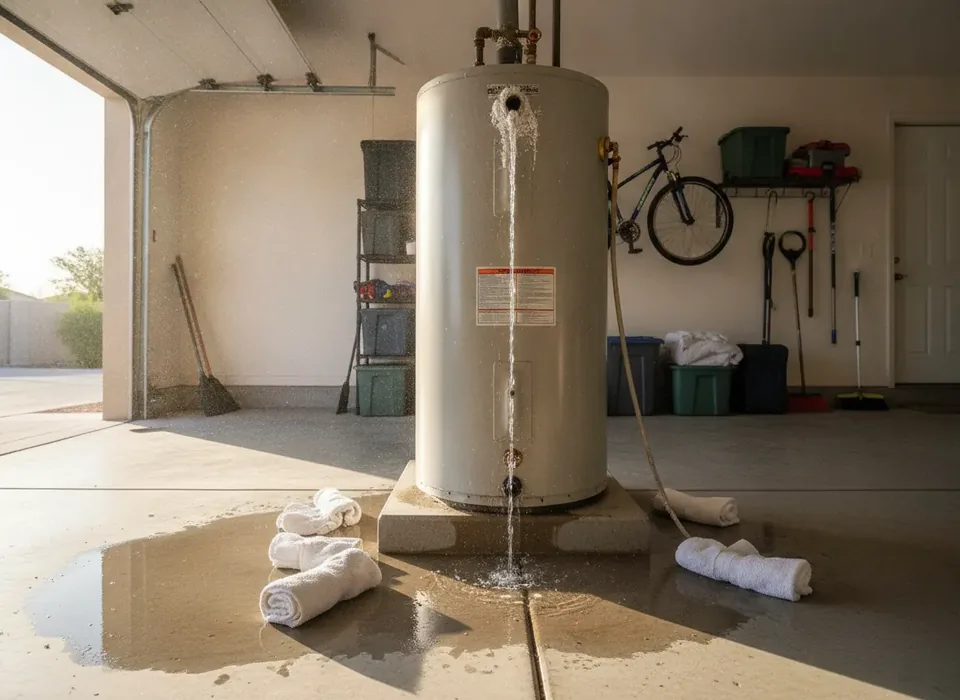
What happens first
Close the water. For a water heater, shut the cold-water valve on top of the tank, then turn the gas valve to off or switch off its breaker. For a pipe or supply line, close the fixture valve if you can reach it, or the main if you can't.
Next, cut power to wet rooms, move boxes and stored items off a wet garage floor, and photograph everything, including the tank's label and the failed part. Keep the failed hose or fitting; your adjuster may want it. Then call Call (727) 300-6656 or send the form. Chandler Water Damage Pros passes your details to independent restoration companies, and you choose which to hire.
The usual suspects in Chandler homes
Most sudden indoor water losses trace back to a short list of parts:
- Tank water heaters. Commonly installed in garages in Valley homes, where a failed tank floods the garage and runs under the door into the house.
- Braided supply lines to toilets, sinks and the refrigerator, which can burst at the crimp.
- Washing machine hoses, a frequent source of gray-water losses.
- Angle stops and shutoff valves that seize or drip after years of scale.
- Water softener and filter connections, often next to the water heater.
- Lines in walls and ceilings, including those rerouted overhead after an earlier slab leak.
If the water is coming up through the floor and you can't find a broken part, the leak may be under the concrete. See slab leak water damage.
Hard water and water heaters
Chandler's water is hard to very hard. The city reports an average of about 16.5 grains per gallon citywide, with a range of roughly 5 to 20 depending on where you live and which source is feeding your area. The Water Quality Association treats anything above 10.5 gpg as very hard.
Scale settles in the bottom of a tank water heater, which makes it run hotter and work harder. It also crusts on valves and fittings. The City of Chandler notes that manufacturers suggest flushing a water heater every year with a softener and every six months without one. Many homes here are 20 to 45 years old, so plenty of houses are on a second or third water heater, and some still have original shutoff valves. More on that in hard water and water heater leaks in Chandler.
What restoration companies do after a pipe or tank failure
The plumber replaces the failed part; the restoration company handles the water it left behind.
Extract and protect
Standing water comes off the garage and house floors. Stored items and furniture are moved or blocked up so they stop wicking water.
Trace the water path
Water from a garage tank often travels under the house door, along the slab and into a wall shared with a laundry or bedroom. Meters show how far it went.
Open wet walls
Drywall in garages and laundry rooms is commonly cut above the wet line so the cavity and bottom plate can dry. In older homes, ask about asbestos testing before cutting.
Dry and verify
Dehumidifiers and air movers run until readings match a dry area. A wall-cavity loss usually needs more drying time than a floor-only spill.
Rebuild
New drywall, texture, baseboard and paint follow. That repair work belongs with an ROC-licensed contractor.
A note on asbestos before tear-out
Maricopa County's Rule 370 requires an AHERA-certified asbestos inspection and a 10-working-day notice before regulated renovations. A single owner-occupied home is exempt, but a rental may not be. In San Tan Valley, the Pinal County Air Quality Control District handles the same questions. Older homes with textured walls or popcorn ceilings deserve a test before drywall comes out. See asbestos before tear-out in Maricopa County.
What it typically costs
Water from a supply line or water heater is usually clean, priced around $3.75–$4.25 per square foot for extraction. Washer overflows are often treated as gray water at $4.10–$6.50. A typical whole job runs $1,200–$5,000, and a Class 2 loss, with water wicking up walls, typically runs $500–$1,000 for the mitigation part. Typical ranges from national cost guides (Fixr 2025, HomeAdvisor 2025); East Valley quotes vary. The water heater or plumbing repair is billed separately by the plumber. See the cost guide.
Insurance: sudden vs. gradual
A pipe that bursts or a tank that splits is the classic sudden, accidental loss most homeowners policies cover, subject to your policy's deductible. The failed water heater itself is often treated as wear and tear and may not be covered. A slow drip that rotted a cabinet base over months is usually excluded. Keep the failed part, the photos and the plumber's invoice. In Arizona, insurers must acknowledge a claim within 10 working days and accept or deny it within 15 working days of a properly completed proof of loss. If you have trouble, DIFI's Consumer Services line is (602) 364-2499.
When to call right away
Call now if water is still running, if it has crossed from the garage into living space, if it reached a wall shared with a bedroom, or if the tank is gas-fired and you smell gas. In that last case, leave the house and call the gas utility first.
Burst pipe and water heater FAQ
How do I shut off a leaking water heater?
Close the cold-water inlet valve on top of the tank to stop new water entering. On a gas unit, turn the gas control knob to off; on an electric unit, switch off its breaker. Don't drain a hot tank yourself unless you know how and the water has cooled. If you smell gas, leave the house and call the gas company.
Does homeowners insurance pay for a new water heater?
Often not. Many policies treat a worn-out tank as maintenance and exclude it, while covering the sudden water damage it caused to floors, walls and belongings. Policies differ, so check your declarations page and ask your adjuster. Keep the old tank or photos of its label and the failure point until the claim is settled.
Can I stay in the house after a pipe burst?
Usually, yes, if the water was clean, the source is off and the electrical in wet rooms is safe. Consider staying elsewhere if the affected area is large, if ceilings are sagging, or if drying equipment will run in bedrooms. If anyone has breathing problems, ask a doctor about extended dehumidifier and air mover noise and dust.
Who fixes the pipe, and who fixes the water damage?
A licensed plumber replaces the failed line, valve or water heater. A restoration company extracts water, removes wet materials and dries the structure, and an ROC-licensed contractor handles the rebuild. Some restoration companies coordinate a plumber; others expect you to. Ask each company you get a quote from how they handle it.
How often should I flush my water heater in Chandler?
The City of Chandler notes that manufacturers suggest flushing every six months if you don't have a water softener, and once a year if you do. Chandler's water averages about 16.5 grains per gallon, so sediment builds up quickly. Flushing won't fix a tank that is already leaking, but it can extend the life of a healthy one.
Get free quotes for pipe or water heater cleanup
Say what failed, where the water went and how long it ran. Independent East Valley restoration companies reply with no-obligation quotes.
Water where it shouldn't be? Get free quotes.
Tell us what happened and independent East Valley restoration companies can reply with no-obligation quotes.