
Hard Water and Water Heater Leaks in Chandler
Chandler's tap water is hard. The city's own water-quality FAQ puts the citywide average at 16.5 grains per gallon, with neighborhoods ranging from about 5 to 20 gpg depending on which source feeds them. The 2025 Consumer Confidence Report lists total hardness of 173–288 mg/L, roughly 10.1–16.8 gpg. On the Water Quality Association's scale, anything over 10.5 gpg counts as "very hard." That mineral load is a quiet, steady reason water heaters and supply lines fail across the East Valley, and a failed tank in a garage or hall closet can put 40 or 50 gallons on the floor before anyone notices.
This guide covers what scale does to a water heater, how to flush one, which small parts give out first, and what to do in the first hour if yours starts leaking.
How hard is Chandler water, and where does it come from?
Chandler blends several supplies. According to the city, about 60% comes from the Salt and Verde rivers through the Consolidated Canal and the city's surface water treatment plant, about 20% comes from the Santan Vista plant that Chandler shares with Gilbert, and the rest is pumped from 32 groundwater wells. Each source carries a different mineral load, which is why one Chandler street can test noticeably softer than another. You can check your own number on the City of Chandler water quality FAQ or the annual Consumer Confidence Report.
The minerals are mostly calcium and magnesium. They are not a health issue. They are a plumbing issue. The City of Phoenix, whose water is similar, notes in its own reports that hard water "can cause some types of scaling in pipes and water heaters."
What hard water does to a water heater
When water is heated, dissolved calcium drops out as scale. In a tank heater it settles on the bottom as a crusty layer of sediment. Over time that layer:
- Insulates the water from the burner or element, so the heater runs longer and hotter to do the same job. Gas units often start to rumble or pop as water trapped under the sediment boils.
- Stresses the tank lining. Overheated steel at the bottom of the tank is where many tanks finally rust through.
- Clogs the drain valve, which makes flushing harder the longer it is put off.
- Wears out the anode rod faster. The anode is the sacrificial metal rod that corrodes so the tank does not. Once it is gone, the tank itself starts to corrode.
Age matters too. About 73% of Chandler's housing was built between 1980 and 2009, and the city's median year built is 1997, per the Census Bureau's American Community Survey. Plenty of those homes are on their second or third water heater, and the connectors, valves and pans around the tank are often the originals or close to it.
How often should you flush a water heater in Chandler?
The City of Chandler passes along the manufacturers' guidance: flush a tank water heater once a year if the home has a water softener and every six months if it does not. That is more often than most people do it, and it is the single cheapest way to stretch a tank's life in hard-water country.
A basic flush, for homeowners comfortable doing it:
Turn the heat source off
Set a gas heater to "pilot" or off. Switch an electric heater off at the breaker. Running an empty electric element can burn it out.
Shut the cold-water inlet
The valve sits on the cold line above the tank. Open a hot tap somewhere in the house so air can enter.
Drain to a safe spot
Attach a garden hose to the drain valve and run it to the driveway or a floor drain. The water is very hot. Let the tank empty, then open the cold inlet briefly to stir up remaining sediment and drain again until it runs clear.
Refill before reheating
Close the drain, open the cold inlet, and wait until the open hot tap runs without sputtering. Then restore gas or power.
If the drain valve will not open, drips after closing, or the water never runs clear, stop and call a plumber. A plastic drain valve that cracks mid-flush is a common way a maintenance job turns into a wet garage. Tankless heaters need a different procedure (descaling with a pump and solution), which the manufacturer's manual spells out.
The small parts that cause big leaks
The tank is not the only failure point. In hard-water homes, these give out often enough to check every time you flush:
- Supply connectors. The flexible lines from the shutoff to the heater, toilets, faucets and washer. Braided lines can fray or corrode at the crimp, and old rubber washer hoses can split. Many plumbers suggest replacing them on a schedule rather than waiting.
- Angle stops and shutoff valves. Scale can freeze them open, so the valve you need in an emergency will not turn. Test them gently once a year.
- Temperature and pressure (T&P) relief valve. A valve that drips or weeps may be reacting to high pressure or may be scaled and failing. Either way, it is a job for a plumber.
- Drain pan and pan line. A pan under the tank catches small leaks, but only if its drain line is clear and actually goes somewhere.
- Hot-water lines in general. Plumbers in the Valley report that hot lines are more prone to leaks, including under-slab leaks. If your water heater runs constantly with no taps open, read the signs of a slab leak.
If the water heater is leaking right now
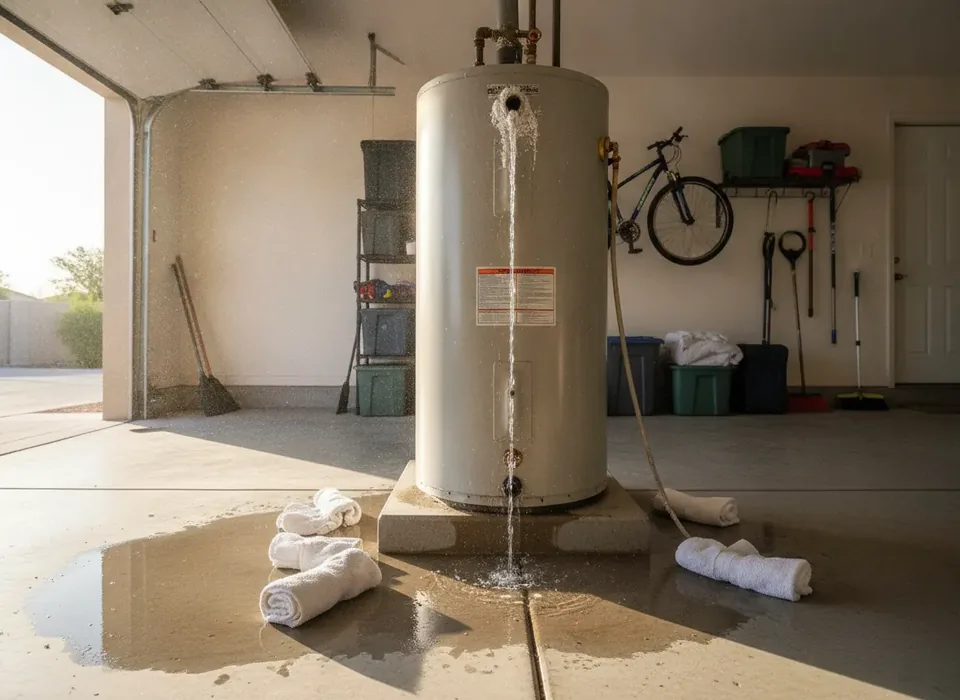
Close the cold-water inlet valve above the tank. If it will not turn, shut the home's main. Turn the gas to off or flip the heater's breaker. Keep people and pets away from scalding water. Move boxes and anything stored on the garage or closet floor. Take photos before you mop. Then call a plumber for the heater and, if water reached drywall, cabinets, flooring or a carpeted room, a restoration company for the drying.
Who fixes what: plumber vs restoration company
A water heater leak is usually two jobs. An ROC-licensed plumber replaces or repairs the heater, valves and lines. A water damage restoration company handles the water that escaped: extraction, moisture mapping, removing wet baseboards or drywall where needed, and running air movers and dehumidifiers until the readings say the structure is dry. The independent East Valley companies we connect you with do the second job. Many will coordinate with your plumber, and any rebuild work should come from a contractor whose license you can confirm at the Arizona Registrar of Contractors. Look for "ROC" plus a license number on the bid.
A garage leak that stays on bare concrete can be a mop-and-fan job. A closet heater that leaked into a hallway, or a leak that ran overnight, is different. Water wicks into drywall and under baseboards and tile, and on a concrete slab it can sit trapped for days. The burst pipe and water heater leak page explains what the drying companies typically do first.
What does cleanup cost, and will insurance help?
National cost guides put clean-water extraction at roughly $3.75–$4.25 per square foot, and a typical whole job at $1,200–$5,000 (Fixr 2025; HomeAdvisor 2025). East Valley quotes vary with how far the water travelled and what has to come out. The Chandler water damage cost guide has a planning calculator.
On insurance, the usual pattern is that a sudden tank or connector failure is more likely to be covered for the resulting water damage, while the worn-out heater itself, and damage from a slow drip that went on for months, often is not. Every policy is different, and your policy's deductible applies. See the Arizona water damage insurance guide and ask your adjuster before assuming either way.
A short hard-water checklist
- Flush the tank every six months without a softener, yearly with one.
- Ask a plumber to check the anode rod every few years.
- Look at the base of the tank and the pan whenever you are in the garage.
- Know where the cold inlet and the house main are, and test that they turn.
- Replace old flexible supply lines before they fail, not after.
- Consider a water leak sensor on the floor next to the heater and washer.
Questions people ask
Is Chandler water hard?
Yes. The City of Chandler lists a citywide average of 16.5 grains per gallon, with a range of about 5 to 20 gpg depending on the source. Anything over 10.5 gpg is considered very hard on the Water Quality Association scale.
How often should I flush my water heater in Chandler?
The city passes along manufacturers' guidance: once a year with a water softener and every six months without one.
Does a water softener prevent water heater leaks?
A softener reduces scale, which can extend tank life, but tanks, valves and connectors still wear out with age. Regular flushing and inspections still matter.
Who do I call when my water heater leaks?
A licensed plumber for the heater itself, and a water damage restoration company if water reached drywall, flooring or cabinets. You can describe the leak once on the free quote form and independent local companies will reply.